Inspection vs Quality Control: What’s the Difference and Why Does It Matter in Manufacturing?
In manufacturing, engineering, fabrication, construction, and industrial projects, the terms Inspection and Quality Control (QC) are often used interchangeably. However, they are not the same.
Both play an important role in maintaining product quality, meeting customer specifications, reducing defects, and improving manufacturing performance. The key distinction is simple:
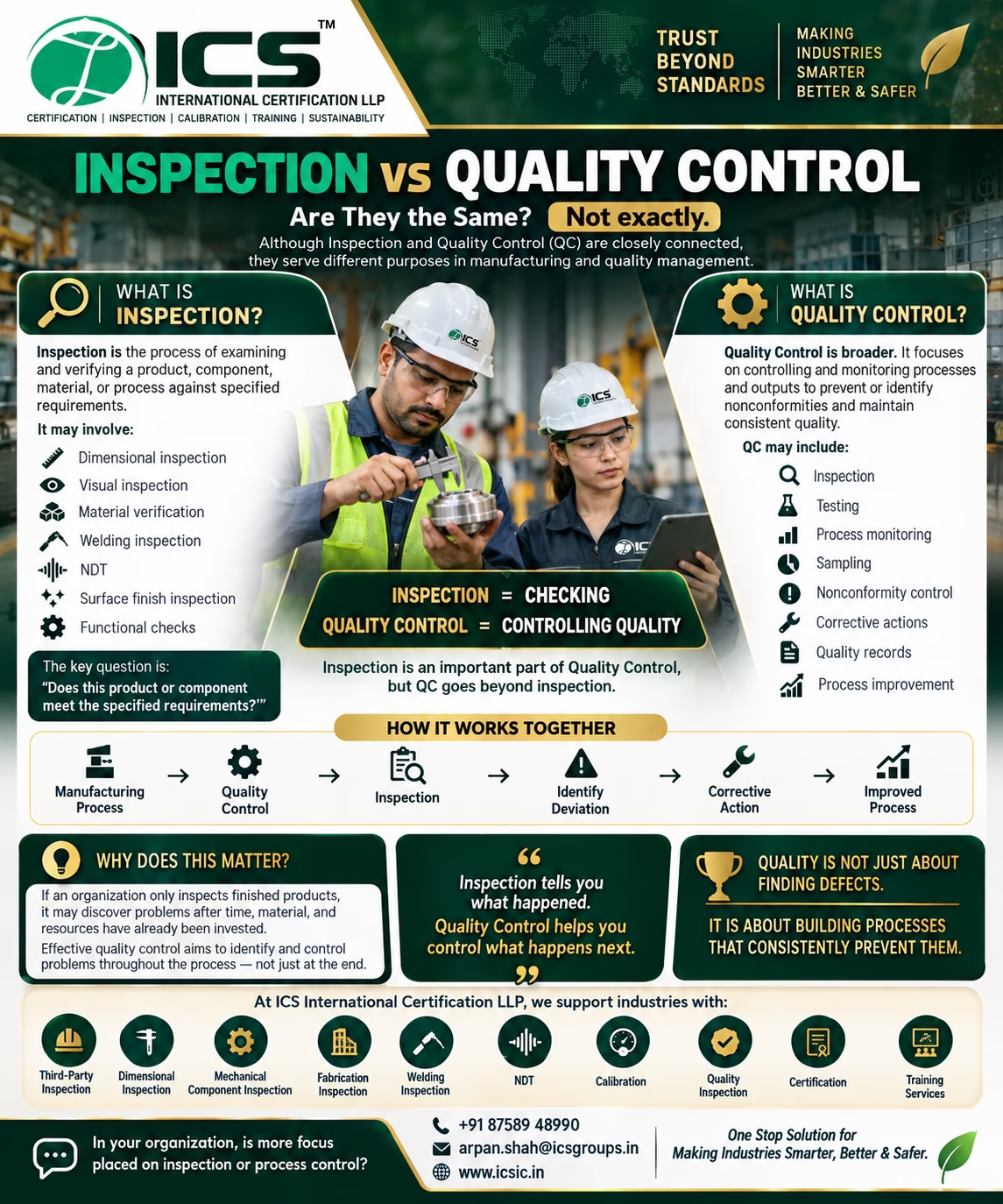
Inspection focuses on checking whether requirements have been met, while Quality Control focuses on controlling quality throughout the process.
Understanding this difference can help manufacturers reduce rework, improve consistency, strengthen supplier quality, and deliver products that meet specified requirements.
What Is Inspection?
Inspection is the systematic examination, measurement, verification, or evaluation of a product, component, material, equipment, or process against specified requirements.
The objective is essentially to answer:
“Does this product, material, component, or process meet the specified requirements?”
Depending on the industry and product, inspection activities may include:
- Dimensional Inspection
- Visual Inspection
- Material Verification
- Welding Inspection
- Non-Destructive Testing (NDT)
- Surface Finish Inspection
- Functional Checks
- Quantity Verification
- Workmanship Inspection
- Pre-Dispatch Inspection
- Incoming Material Inspection
- In-Process Inspection
- Final Inspection
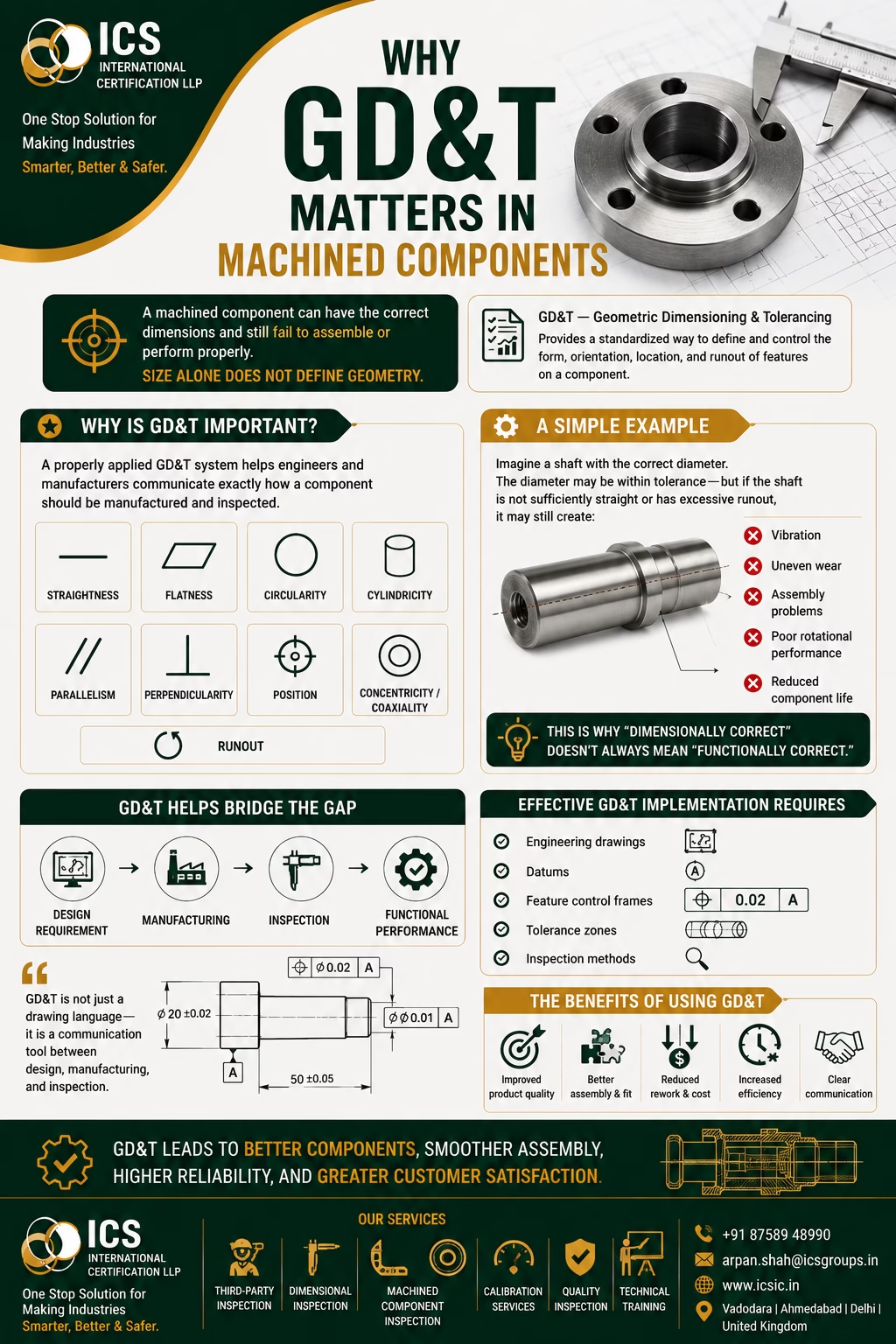
For example, during the manufacturing of a machined component, an inspector may verify dimensions using calibrated measuring equipment and compare the results with the approved engineering drawing and specified tolerances.
If the measurements comply with the specified acceptance criteria, the component may be accepted. If not, the deviation needs to be evaluated and appropriately controlled.
What Is Quality Control?
Quality Control is a broader system of activities used to monitor, control, verify, and improve processes and outputs so that specified quality requirements are consistently achieved.
Quality Control may include:
Inspection + Testing + Process Monitoring + Sampling + Nonconformity Control + Corrective Action + Quality Records + Improvement
QC therefore does not begin only when a finished product reaches the inspection table.
Effective Quality Control can operate throughout the complete manufacturing cycle, from incoming material through production, testing, inspection, release, and delivery.
Typical QC activities may include:
- Incoming material verification
- Review of material certificates
- Process monitoring
- Inspection and testing
- Sampling
- Verification of measuring equipment
- Welding quality control
- NDT coordination
- Identification of nonconforming products
- Root-cause analysis
- Corrective actions
- Inspection and test records
- Supplier quality monitoring
- Final product verification
- Continuous improvement
Inspection vs Quality Control: The Simple Difference
| Inspection | Quality Control |
|---|---|
| Focuses on verification | Focuses on controlling quality |
| Checks products, materials or processes | Controls processes and outputs |
| Identifies deviations or defects | Helps identify, control and prevent recurrence |
| Can occur at defined inspection stages | Can operate throughout the production cycle |
| Uses drawings, specifications and acceptance criteria | Uses inspection, testing, monitoring and quality controls |
| Inspection = Checking | QC = Controlling Quality |
Therefore:
Inspection is an important part of Quality Control, but Quality Control goes beyond inspection.
How Inspection and Quality Control Work Together
A strong manufacturing quality system can follow a sequence such as:
Manufacturing Process → Quality Control → Inspection & Testing → Identify Deviation → Nonconformity Control → Corrective Action → Process Improvement
Consider a fabricated steel component.
Inspection may identify that a critical dimension is outside the specified tolerance. Finding the deviation is important—but simply rejecting or reworking the component does not necessarily prevent the same problem from happening again.
An effective Quality Control process may investigate:
Why did the deviation occur?
Was it caused by incorrect machine settings? Tool wear? An outdated drawing? Measurement error? Operator competency? Material variation? An ineffective process control?
Addressing the underlying cause can reduce the possibility of recurrence.
Why Is Inspection Important in Manufacturing?
Industrial inspection provides objective evidence about whether specified requirements have been satisfied.
It can help organizations:
- Verify conformity with drawings and specifications
- Detect defects before dispatch
- Confirm dimensional requirements
- Verify materials and workmanship
- Identify manufacturing deviations
- Reduce the risk of nonconforming products reaching customers
- Improve traceability through inspection records
- Support supplier and vendor quality management
- Improve customer confidence
For critical industrial equipment and components, appropriate inspection can be especially important because manufacturing defects may lead to significant operational, financial, or safety consequences.
Why Is Quality Control Important?
A company that relies only on final inspection may identify defects after significant time, material, labour, machine capacity, and resources have already been invested.
Quality Control aims to manage quality throughout the process.
Effective QC can contribute to:
Reduced Rework → Reduced Rejection → Better Process Control → Consistent Product Quality → Lower Quality Costs → Improved Customer Satisfaction
This is why organizations should not treat inspection as their entire quality management strategy.
Inspection tells you what happened. Quality Control helps you control what happens next.
What Is Third-Party Inspection?
Third-Party Inspection (TPI) involves inspection performed by an independent inspection organization to verify specified requirements related to products, equipment, materials, manufacturing activities, or projects.
Depending on the agreed inspection scope, third-party inspection activities may include:
- Raw Material Inspection
- Vendor Inspection
- Dimensional Inspection
- Mechanical Component Inspection
- Fabrication Inspection
- Welding Inspection
- NDT Witnessing or Verification
- Visual Inspection
- Stage Inspection
- Final Inspection
- Pre-Dispatch Inspection
- Quantity Verification
- Documentation Review
- Inspection Release Activities
Independent inspection can be useful when buyers, manufacturers, EPC contractors, project owners, or other interested parties require additional verification before acceptance or dispatch.
Inspection Services by ICS International Certification LLP
ICS International Certification LLP supports manufacturing, engineering, fabrication, infrastructure, and industrial organizations through professional inspection and conformity-related services.
Our service portfolio includes:
Third-Party Inspection | Dimensional Inspection | Mechanical Component Inspection | Fabrication Inspection | Welding Inspection | NDT | Calibration | Quality Inspection | Certification | Training
Our objective is to support industries in strengthening product conformity, process reliability, quality management, and technical confidence.
One Stop Solution for Making Industries Smarter, Better & Safer.
For Third-Party Inspection and industrial quality requirements:
ICS International Certification LLP
📞 +91 87589 48990
📧 arpan.shah@icsgroups.in
🌐 www.icsic.in
Frequently Asked Questions About Inspection and Quality Control
Is inspection the same as Quality Control?
No. Inspection is primarily a verification activity used to determine whether specified requirements are met. Quality Control is broader and can include inspection, testing, monitoring, nonconformity control, corrective actions, and other activities for controlling quality.
Is inspection part of Quality Control?
Yes. Inspection is commonly one of the important activities within Quality Control.
What is the difference between Quality Assurance and Quality Control?
Quality Assurance (QA) is generally focused on establishing confidence that quality requirements will be fulfilled through planned and systematic arrangements, while QC focuses more directly on operational techniques and activities used to fulfil quality requirements.
Why is third-party inspection required?
Third-party inspection may be specified by a buyer, contract, project requirement, regulation, quality plan, or other agreed requirement to provide independent verification of specified characteristics or activities.
When should inspection be performed?
Depending on the product and applicable requirements, inspection can be performed during incoming material inspection, in-process manufacturing, hold/witness stages, final inspection, and pre-dispatch inspection.