Hold Point vs Witness Point – What’s the Difference?
In third-party inspection, fabrication, welding, manufacturing, and project quality control, the Inspection & Test Plan (ITP) is one of the most important documents for controlling inspection activities.
Two terms that frequently appear in an ITP are:
Hold Point (HP) and Witness Point (WP).
Although they may sound similar, they have a very different impact on production and inspection activities.
Understanding the difference can help prevent unauthorized progression, missed inspections, project delays, and contractual disputes.
What Is an Inspection & Test Plan (ITP)?
An Inspection & Test Plan (ITP) is a documented plan that identifies inspection, testing, verification, and approval activities throughout a project or manufacturing process.
An ITP may identify different inspection stages using designations such as:
- H – Hold Point
- W – Witness Point
- R – Review
- S – Surveillance
The exact definitions and requirements should always be established by the applicable contract, project specification, approved ITP, procedures, and customer requirements.
Among these, Hold Points and Witness Points are particularly important because they determine how an inspection activity affects the progression of work.
🛑 What Is a Hold Point?
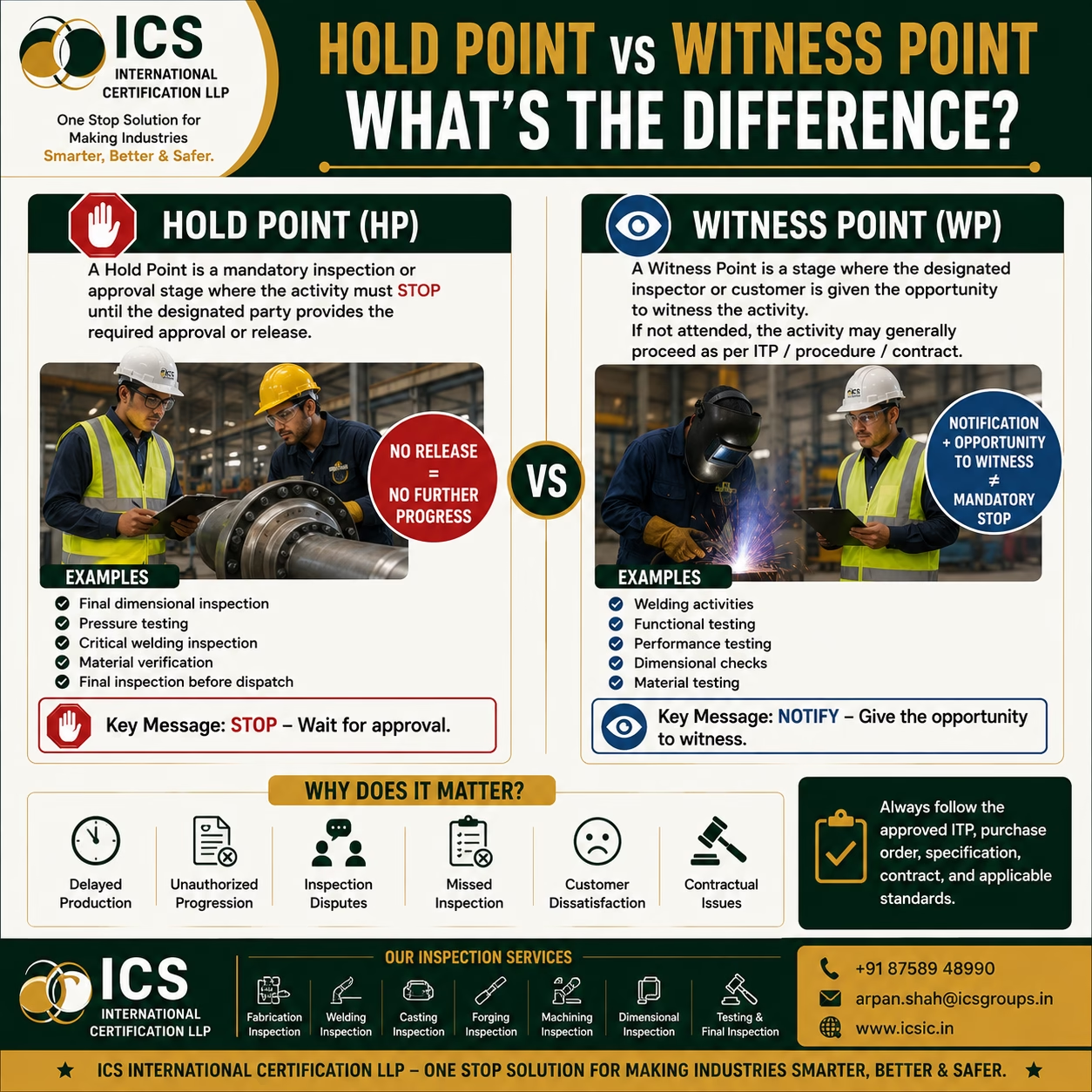
A Hold Point (HP) is a mandatory inspection or approval stage where the specified activity must not proceed beyond the defined point until the required inspection, verification, or release has been completed.
In simple words:
HOLD POINT = STOP AND WAIT FOR RELEASE
The designated party—such as a client, third-party inspector, purchaser, or authorized representative—must complete the required action before the work can continue.
Examples of Hold Points
Depending on the project requirements, Hold Points may be established for:
- Material verification
- Final dimensional inspection
- Critical welding inspection
- Pressure testing
- Final inspection
- Inspection before painting or coating
- Inspection before closing or inaccessible assembly
- Final inspection before dispatch
The exact Hold Points should always be defined in the approved ITP.
Why Are Hold Points Important?
Hold Points are used when an inspection activity is considered sufficiently important that the next stage should not proceed without the required release.
For example, imagine a fabricated pressure vessel where an inspection is required before a component becomes inaccessible.
If the manufacturer closes the component before inspection, the inspector may no longer be able to adequately verify the required condition.
A Hold Point can prevent this situation.
The basic principle is:
Inspection → Approval/Release → Continue Work
Without the required release:
No release → No further progression beyond the Hold Point
👁️ What Is a Witness Point?
A Witness Point (WP) is a stage where the designated party is given the opportunity to witness a specified inspection, test, or activity.
The responsible party is normally notified according to the agreed procedure and has the opportunity to attend.
However, unlike a Hold Point, the activity is generally not automatically stopped indefinitely simply because the witness does not attend, provided the applicable ITP, procedure, contract, and notification requirements permit the activity to proceed.
In simple words:
WITNESS POINT = NOTIFY AND GIVE THE OPPORTUNITY TO WITNESS
The exact rules should always be taken from the approved project documentation.
Examples of Witness Points
Depending on the project requirements, Witness Points may include:
- Welding activities
- Functional testing
- Performance testing
- Dimensional checks
- Material testing
- Pressure testing
- Manufacturing process stages
- Other specified inspection activities
The important factor is that the designated party receives the required notification and opportunity to witness the activity.
Hold Point vs Witness Point: The Simple Difference
The easiest way to remember the difference is:
🛑 HOLD POINT
STOP – Wait for the required approval or release.
👁️ WITNESS POINT
NOTIFY – Give the designated party the opportunity to witness.
However, the exact contractual meaning always depends on the approved ITP and project requirements.
What Happens at a Hold Point?
A typical Hold Point process may look like this:
Step 1 – Activity Approaches Hold Point
The manufacturer or contractor completes the required preparation.
Step 2 – Inspection Notification
The responsible inspection party is notified according to the agreed requirements.
Step 3 – Inspection Takes Place
The designated inspector or authorized party performs or witnesses the required verification.
Step 4 – Results Are Reviewed
Inspection results and applicable acceptance criteria are evaluated.
Step 5 – Release
If the requirements are satisfied, the Hold Point is released according to the applicable process.
Step 6 – Work Continues
The manufacturer can proceed with the next stage.
What Happens at a Witness Point?
The process is slightly different.
Step 1 – Activity Approaches Witness Point
The manufacturer prepares for the specified activity.
Step 2 – Notification
The designated party is informed within the required notification period.
Step 3 – Opportunity to Witness
The inspector or customer has the opportunity to attend.
Step 4 – Witness Activity
If the designated party attends, the inspection or test is witnessed.
Step 5 – Proceed According to Requirements
If the designated party does not attend within the applicable notification arrangements, the activity may generally proceed according to the approved ITP, contract, procedure, and agreed requirements.
Common Mistake: Treating HP and WP as the Same
One of the most common project-quality mistakes is assuming:
Hold Point = Witness Point
They are not necessarily equivalent.
If a Hold Point is treated like a Witness Point, work could continue without the required release.
If a Witness Point is unnecessarily treated as a Hold Point, production could be delayed even though the applicable requirements allow the activity to proceed.
This can lead to:
❌ Production delays
❌ Missed inspection stages
❌ Unauthorized progression
❌ Inspection disputes
❌ Additional costs
❌ Customer dissatisfaction
❌ Contractual disagreements
Why the ITP Is So Important
The Inspection & Test Plan should clearly establish how each inspection point is controlled.
Before starting work, all parties should understand:
- What needs to be inspected?
- When does it need to be inspected?
- Who performs the inspection?
- Who needs to be notified?
- Is it a Hold Point?
- Is it a Witness Point?
- What documents are required?
- What acceptance criteria apply?
- What records need to be generated?
- Can work proceed if the inspector does not attend?
Clear definitions reduce confusion between the manufacturer, purchaser, client, and inspection agency.
Hold Points in Welding Inspection
Welding projects often contain important inspection stages.
Depending on project requirements, an ITP may identify activities such as:
- Welding procedure review
- Welder qualification review
- Material identification
- Fit-up inspection
- Preheating verification
- Welding inspection
- Visual inspection
- NDT
- Post-weld heat treatment
- Pressure testing
- Final inspection
Not every activity is necessarily a Hold Point or Witness Point.
The designation should be determined by the approved ITP and contractual requirements.
Hold Points in Fabrication Inspection
Fabrication projects can involve multiple stages where inspection is required.
Examples may include:
Material Receiving → Cutting → Fit-Up → Welding → NDT → Dimensional Inspection → Surface Preparation → Coating → Final Inspection → Dispatch
Some stages may be designated as Hold Points, while others may be Witness Points, Review Points, or Surveillance activities.
This helps create a controlled inspection sequence.
Hold Points in Casting and Forging Inspection
For castings and forgings, inspection controls may include:
- Raw material verification
- Chemical analysis
- Mechanical testing
- Heat treatment
- Dimensional inspection
- Visual inspection
- Surface NDT
- Volumetric NDT
- Final inspection
- Documentation review
Again, the designation of HP or WP depends on the specific project requirements.
What Is the Role of a Third-Party Inspector?
A Third-Party Inspector (TPI) can provide independent inspection or verification according to the agreed scope.
Depending on the assignment, a third-party inspector may:
🔹 Review drawings and specifications
🔹 Review the approved ITP
🔹 Verify material identification
🔹 Witness testing
🔹 Perform or witness dimensional inspection
🔹 Review NDT reports
🔹 Witness pressure tests
🔹 Conduct visual inspection
🔹 Review quality documentation
🔹 Verify final inspection requirements
🔹 Report inspection findings
The inspector’s authority and responsibilities should be clearly established in the inspection assignment and applicable contractual documents.
What If a Hold Point Is Missed?
Missing a Hold Point can be a serious quality-control issue.
For example:
Hold Point → Inspector not called → Activity proceeds → Component becomes inaccessible
At this stage, the organization may need to determine how the requirement can be satisfactorily addressed.
Possible actions depend on the specific circumstances and contractual requirements and may include:
- Additional inspection
- Re-inspection
- Review of records
- Technical evaluation
- Non-conformance management
- Customer approval
- Corrective action
The best approach is prevention:
Know the Hold Points before production begins.
How to Avoid HP/WP Problems
Organizations can reduce inspection disputes by following a few basic practices.
✅ Review the ITP Before Starting Work
Production and inspection teams should understand the inspection sequence.
✅ Clearly Identify HP and WP
Ensure the inspection designations are understood by all relevant parties.
✅ Maintain Proper Notification
Provide inspection notifications within the agreed timeframe.
✅ Maintain Inspection Records
Document inspection results, approvals, releases, and relevant communications.
✅ Don’t Assume
If the ITP is unclear, clarify the requirement before proceeding.
✅ Follow the Contract
The approved ITP, purchase order, specification, procedure, and applicable standards should govern the inspection process.
The Key Difference
The simplest way to remember the concept:
🛑 HOLD POINT
“STOP – inspection/release is required before proceeding.”
👁️ WITNESS POINT
“NOTIFY – provide the opportunity to witness.”
But remember: the exact contractual definition always takes priority.
Final Thoughts
Hold Points and Witness Points are essential tools for controlling inspection activities in manufacturing and industrial projects.
They help define:
When to stop.
When to notify.
When to inspect.
When work can proceed.
A well-prepared ITP ensures that everyone understands their responsibilities before production begins.
🎯 Remember:
A Hold Point controls progression. A Witness Point provides an opportunity to witness.
Clear inspection planning can help prevent missed inspections, unauthorized progression, production delays, and quality disputes.
Third-Party Inspection Services by ICS International Certification LLP
ICS International Certification LLP provides third-party and industrial inspection support for various manufacturing and engineering activities, including:
🔹 Fabrication Inspection
🔹 Welding Inspection
🔹 Casting Inspection
🔹 Forging Inspection
🔹 Machining Inspection
🔹 Dimensional Inspection
🔹 NDT Inspection
🔹 Final Inspection
🔹 Pre-Dispatch Inspection
🔹 Testing & Quality Verification
Our objective is to support industries in maintaining effective inspection and quality-control processes.
📞 +91 87589 48990
📧 arpan.shah@icsgroups.in
🌐 www.icsic.in
ICS International Certification LLP
One Stop Solution for Making Industries Smarter, Better & Safer.