Welder Qualification: Why Is It Important for Welding Quality?
Welding is one of the most important manufacturing and fabrication processes used across industries such as construction, oil and gas, power, automotive, engineering, infrastructure, and heavy fabrication.
A weld may look acceptable visually, but appearance alone cannot demonstrate that the welding process has been performed correctly or that the welder is capable of consistently producing acceptable welds.
This is where Welder Qualification becomes important.
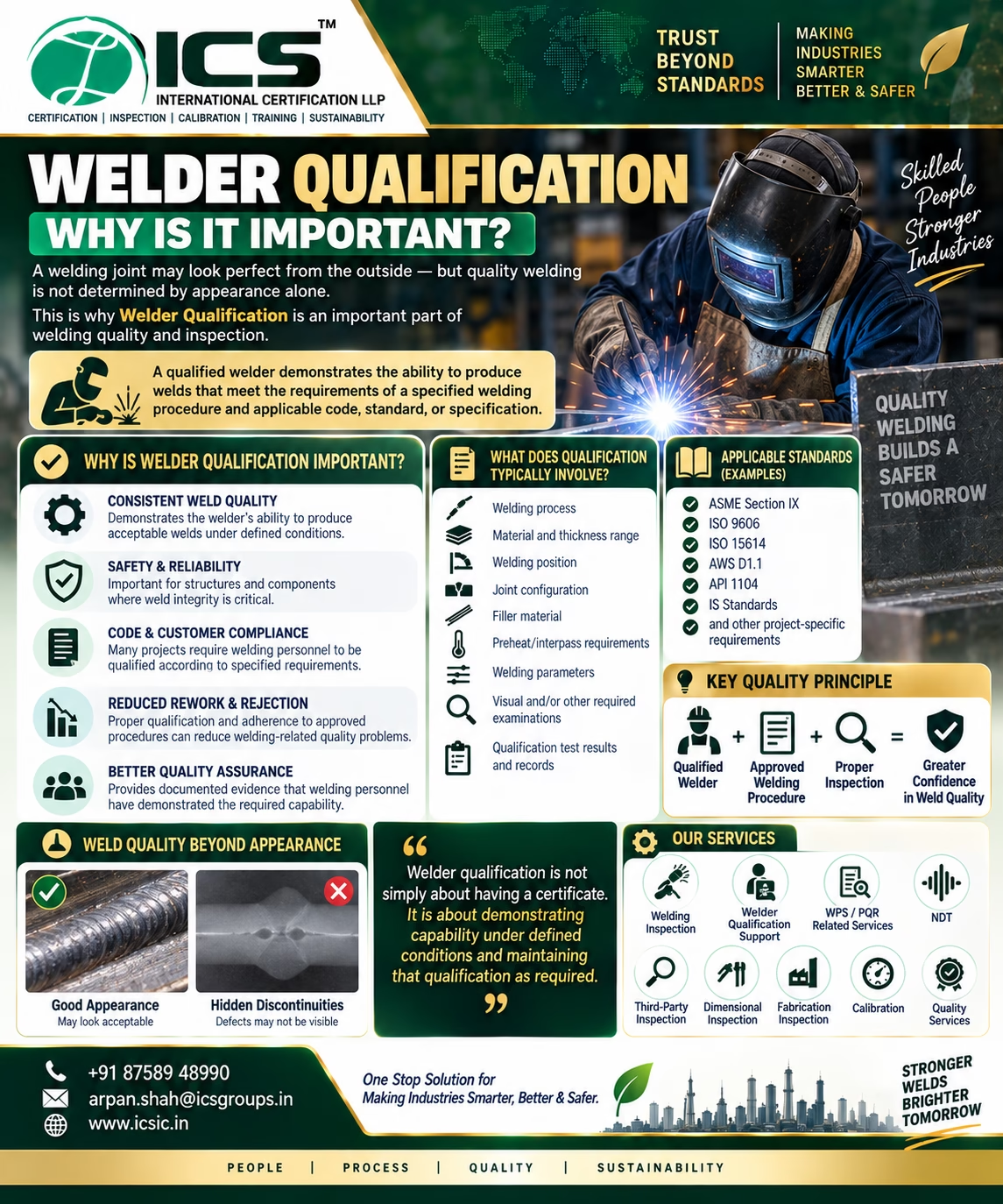
Welder qualification provides evidence that a welder has demonstrated the ability to produce an acceptable weld under specified conditions and within the applicable qualification requirements.
The basic principle is:
Qualified Welder + Approved Welding Procedure + Proper Inspection = Greater Confidence in Weld Quality
What Is Welder Qualification?
Welder Qualification is a process used to demonstrate that an individual welder or welding operator has the required ability to produce welds that meet specified acceptance requirements under defined conditions.
Qualification requirements can vary depending on the applicable:
- Welding code
- Standard
- Project specification
- Customer requirement
- Material
- Welding process
- Joint type
- Thickness
- Position
- Filler material
A welder qualification record provides documented evidence of the qualification test and the conditions under which the welder was qualified.
Why Is Welder Qualification Important?
Welder qualification is not simply about obtaining a certificate.
It is about demonstrating welding capability under controlled conditions.
1. Ensures Demonstrated Welding Capability
A qualification test provides an opportunity to demonstrate that the welder can produce an acceptable weld using a specified welding process and defined variables.
This gives manufacturers and customers greater confidence in the welder’s capability.
2. Supports Consistent Weld Quality
Welding quality can be influenced by:
- Welder skill
- Welding parameters
- Joint preparation
- Welding position
- Material
- Filler metal
- Heat input
- Preheat and interpass temperature
- Welding technique
Qualification helps establish that the welder has demonstrated the required capability for the applicable conditions.
3. Helps Meet Project and Customer Requirements
Many industrial projects specify requirements for qualified welding personnel.
Depending on the project, the required qualification may be governed by a particular code or standard.
Having properly qualified personnel can therefore be an important part of demonstrating compliance with project requirements.
4. Reduces Welding-Related Rework
Poor welding can result in defects that require repair.
Examples may include:
- Porosity
- Cracks
- Lack of fusion
- Lack of penetration
- Undercut
- Slag inclusions
- Excessive reinforcement
- Dimensional distortion
Appropriate welder qualification, combined with proper welding procedures and inspection, can help reduce the risk of welding-related quality problems.
5. Improves Safety and Reliability
In critical structures and equipment, weld integrity can be directly related to safety and service performance.
Examples include:
- Pressure-containing equipment
- Storage tanks
- Pipelines
- Structural steel
- Heavy machinery
- Lifting structures
- Industrial equipment
Qualified welding personnel are therefore an important element of a controlled welding quality system.
What Does a Welder Qualification Test Involve?
The exact qualification requirements depend on the applicable code, standard, and project requirements.
A typical qualification process may involve a practical welding test followed by required examination or testing.
The qualification may consider variables such as:
🔹 Welding Process
Examples include:
- SMAW
- GTAW
- GMAW
- FCAW
- SAW
The applicable process depends on the qualification requirement.
🔹 Base Material
The material type and relevant material grouping may be important qualification variables.
🔹 Thickness
The thickness of the test coupon can determine the qualified thickness range according to the applicable requirements.
🔹 Welding Position
Qualification may involve positions such as:
- Flat
- Horizontal
- Vertical
- Overhead
The qualified positions depend on the applicable code and test conditions.
🔹 Joint Configuration
The test may involve a particular joint configuration, such as a groove or fillet weld, depending on the qualification requirements.
🔹 Filler Material
The filler metal classification and relevant variables may also be controlled.
🔹 Preheat and Interpass Conditions
Specified temperature controls may be relevant to the qualification and subsequent welding work.
Welder Qualification Is Not the Same as WPS/PQR
This is an important distinction in welding quality.
WPS – Welding Procedure Specification
A WPS describes how a welding operation is to be performed.
It can define items such as:
- Welding process
- Base material
- Filler material
- Current
- Voltage
- Welding position
- Preheat
- Interpass temperature
- Other essential or relevant variables as required
PQR – Procedure Qualification Record
A PQR records the actual variables used during a procedure qualification test and the resulting test results.
Welder Qualification
Welder qualification demonstrates the welder’s ability to produce an acceptable weld under the specified qualification conditions.
In simple terms:
WPS = How the welding should be performed
PQR = Evidence from procedure qualification
Welder Qualification = Demonstrated ability of the welder
These three elements can work together as part of a controlled welding system.
What Tests May Be Used for Welder Qualification?
The tests required depend on the applicable code or specification.
Qualification examinations may include methods such as:
👁️ Visual Examination
The test weld may be visually examined for specified surface conditions and acceptance requirements.
🔬 Non-Destructive Testing
Depending on the applicable requirements, methods such as:
- Radiographic Testing (RT)
- Ultrasonic Testing (UT)
- Liquid Penetrant Testing (PT)
- Magnetic Particle Testing (MT)
may be used where applicable.
🧪 Destructive Testing
Certain qualification requirements may involve destructive tests such as:
- Bend testing
- Tensile testing
- Fracture testing
- Other specified mechanical tests
The exact test method and acceptance criteria must be determined by the applicable standard or code.
What Happens If a Welder Fails Qualification?
If a qualification test does not meet the applicable acceptance criteria, the welder may not be qualified for the intended scope based on that test.
The appropriate action depends on the applicable requirements and may include:
- Reviewing the cause of failure
- Correcting the welding technique
- Additional training
- Requalification
- Repeat testing where permitted
- Reviewing the welding procedure and test conditions
A failed qualification should be treated as an opportunity to identify and correct the underlying issue rather than simply repeating the test without understanding the cause.
Common Reasons for Welding Qualification Failure
Qualification failures can occur for several reasons.
❌ Poor Joint Preparation
Incorrect joint geometry or preparation can affect weld quality.
❌ Incorrect Welding Parameters
Improper current, voltage, travel speed, or other parameters can influence the weld.
❌ Poor Welding Technique
Incorrect electrode manipulation, travel angle, or travel speed can contribute to defects.
❌ Inadequate Preheating
Where preheat is required, failure to maintain specified conditions can affect welding performance.
❌ Contamination
Oil, moisture, dirt, rust, or other contaminants can contribute to welding defects.
❌ Poor Interpass Control
Improper interpass temperature management can affect the welding process.
❌ Lack of Welder Skill
Inadequate practical skill or insufficient experience with the applicable welding process can result in defects.
Welder Qualification and Welding Inspection
Welder qualification is closely connected to welding inspection.
Inspection personnel may review relevant documentation to verify that welding personnel are appropriately qualified for the work being performed.
Depending on the project, documentation may include:
- Welder qualification records
- Welding procedure specifications
- Procedure qualification records
- Welder identification
- Welding logs
- Consumable records
- Inspection reports
- NDT reports
Documentation requirements depend on the project and applicable standards.
Welder Qualification in Fabrication
In fabrication industries, welding can be used to manufacture:
- Structural components
- Pressure vessels
- Tanks
- Piping
- Machinery
- Frames
- Platforms
- Industrial structures
Because these products may have critical welds, controlling welding personnel competency is an important part of fabrication quality assurance.
A strong fabrication quality system should connect:
Qualified Personnel → Approved Procedure → Controlled Welding → Inspection → Documentation
Importance of Welder Identification and Traceability
For quality-critical fabrication, it can be important to maintain traceability between the welder and the weld performed.
Depending on project requirements, weld identification may be linked to:
- Welder ID
- Weld number
- Joint number
- Welding procedure
- Material identification
- Inspection records
- NDT reports
Traceability helps organizations identify who performed a particular weld and connect the welding activity with its associated quality records.
How Welder Qualification Supports Quality Assurance
A properly controlled welder qualification system can help organizations:
✅ Demonstrate welder competency
✅ Support consistent welding quality
✅ Reduce welding-related defects
✅ Reduce rework and repair costs
✅ Meet applicable project requirements
✅ Improve traceability
✅ Strengthen quality documentation
✅ Support welding inspection
✅ Improve customer confidence
However, qualification should be considered as one component of the overall welding quality system.
Welder Qualification Does Not Guarantee a Defect-Free Weld
This is an important point.
A welder being qualified does not mean every weld they produce will automatically be acceptable.
Actual weld quality can still be affected by:
- Material condition
- Welding procedure
- Joint preparation
- Welding parameters
- Consumables
- Equipment
- Environment
- Fit-up
- Preheat
- Welder technique
- Inspection
Therefore, welder qualification should work together with WPS control, welding supervision, inspection, NDT, and quality assurance activities.
A Simple Welding Quality Chain
A reliable welding process can be viewed as:
Qualified Welder
↓
Approved Welding Procedure
↓
Correct Material & Consumables
↓
Controlled Welding Parameters
↓
Welding Inspection
↓
NDT / Testing Where Required
↓
Final Acceptance
Each stage contributes to confidence in the finished weld.
Why Welder Qualification Matters to Customers
For customers, project owners, EPC contractors, and quality teams, welder qualification provides documented evidence that welding personnel have demonstrated their ability under defined conditions.
This can support confidence in:
- Welding competency
- Project compliance
- Quality documentation
- Inspection readiness
- Manufacturing control
- Traceability
It is especially important when welding is associated with safety-critical or highly regulated applications.
How Companies Can Strengthen Welder Qualification Control
Organizations can improve their welding quality management by:
1. Maintaining Current Qualification Records
Keep welder qualification documentation properly controlled.
2. Matching Welder Qualification to the Work
Ensure the welder’s qualification covers the applicable conditions according to the governing requirements.
3. Controlling Welding Procedures
Ensure welders have access to the applicable approved welding procedure.
4. Monitoring Qualification Validity
Follow the applicable requirements for maintaining welder qualification and continuity.
5. Providing Appropriate Training
Identify skill gaps and provide suitable training or practice.
6. Maintaining Traceability
Where required, maintain links between welds, welders, procedures, and inspection records.
Final Takeaway
Welder Qualification is an important part of welding quality assurance.
It provides evidence that a welder has demonstrated the ability to produce acceptable welds under defined qualification conditions.
But successful welding requires more than a qualification certificate.
It requires:
Qualified Welder + Correct Procedure + Proper Equipment + Controlled Parameters + Effective Inspection
When these elements work together, organizations can build a stronger and more reliable welding quality system.
A qualified welder doesn’t just hold a certificate—they demonstrate the capability to produce quality welds under defined conditions.
🔥 Weld with Skill. Inspect with Confidence. Build with Quality.
About ICS International Certification LLP
ICS International Certification LLP provides professional inspection, certification, calibration, training, and quality-related services to industries.
Our services include:
🔹 Welder Qualification Support
🔹 Welding Inspection
🔹 WPS/PQR-Related Services
🔹 NDT Inspection
🔹 Visual Inspection
🔹 Dimensional Inspection
🔹 Third-Party Inspection
🔹 Fabrication Inspection
🔹 Mechanical Component Inspection
🔹 Calibration Services
🔹 Quality Inspection
🔹 Management System Certification
🔹 Training & Competency Development
One Stop Solution for Making Industries Smarter, Better & Safer.
📞 +91 87589 48990
📧 arpan.shah@icsgroups.in
🌐 www.icsic.in