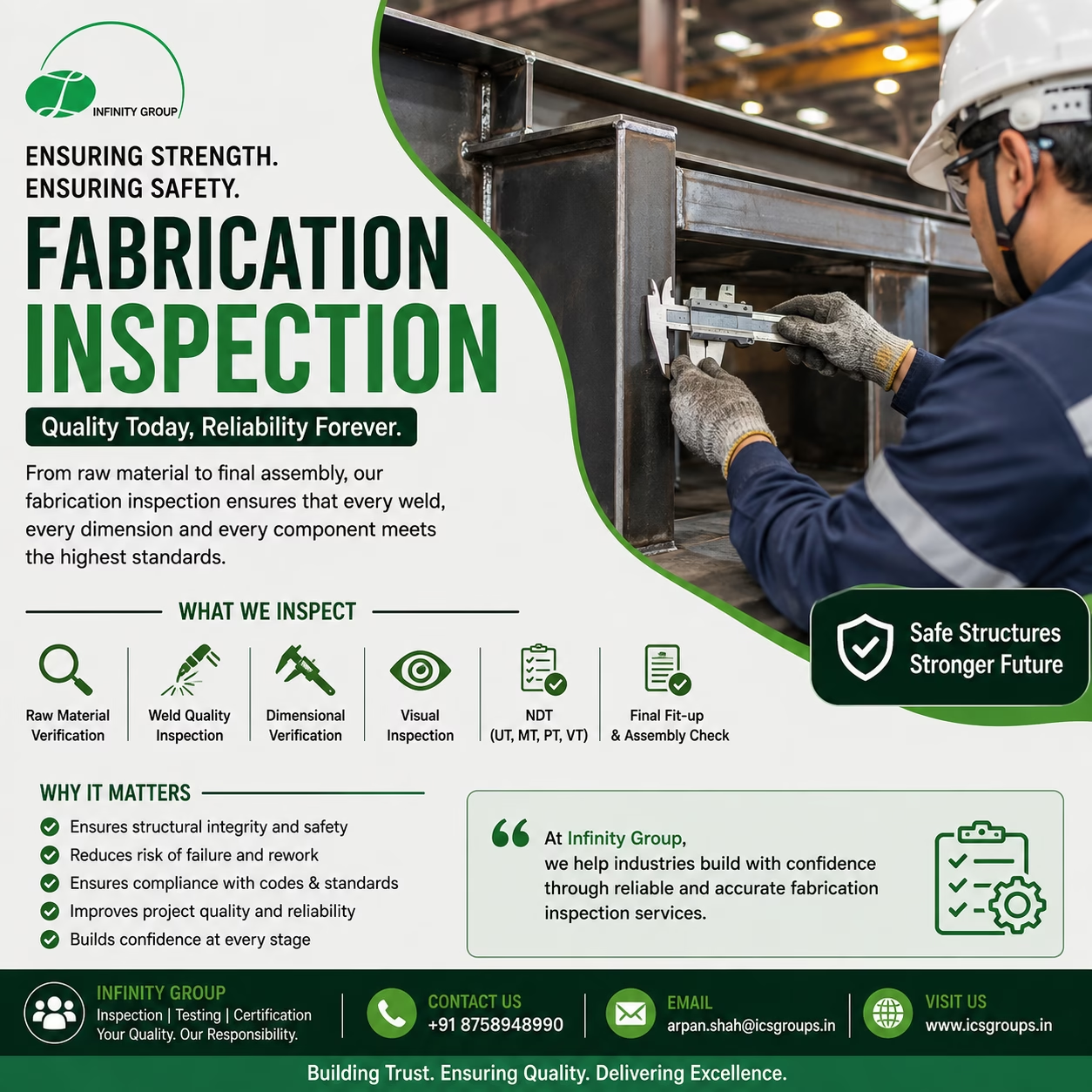
Fabrication Inspection: Complete Guide to Quality, Welding, Dimensions & Third-Party Inspection
Fabrication inspection is a critical quality-control activity that helps verify whether fabricated structures and components meet approved drawings, specifications, standards, and customer requirements.
Fabricated products are widely used across construction, structural engineering, oil & gas, power generation, automotive, heavy engineering, infrastructure, manufacturing, and industrial equipment.
A fabrication may look acceptable visually, but defects in material, welding, dimensions, alignment, or assembly can affect its strength, safety, performance, and service life.
This is why a properly planned fabrication inspection process is essential.
What Is Fabrication Inspection?
Fabrication inspection is the systematic examination and verification of fabricated components during different stages of manufacturing.
Depending on the project and inspection requirements, inspection may cover:
- Raw material verification
- Material traceability
- Cutting and preparation
- Welding and weld quality
- Dimensional inspection
- Visual inspection
- Non-Destructive Testing (NDT)
- Fit-up inspection
- Final assembly
- Surface condition
- Marking and identification
- Documentation review
The inspection requirements should be established based on the approved drawings, purchase order, specifications, Inspection & Test Plan (ITP), applicable codes/standards, and customer requirements.
Why Is Fabrication Inspection Important?
Fabrication defects can become increasingly expensive to correct as manufacturing progresses.
For example, identifying a dimensional problem during final assembly may require significant rework. Identifying the same issue during an intermediate inspection can make correction much easier.
Effective fabrication inspection can help organizations:
✅ Reduce Rework and Rejection
Potential non-conformities can be identified before the product reaches the final stage.
✅ Improve Structural Integrity
Inspection helps verify important material, welding, dimensional, and assembly requirements.
✅ Verify Compliance
Fabricated components can be checked against approved drawings, specifications, ITPs, and applicable requirements.
✅ Improve Supplier Quality
Independent inspection provides additional visibility into manufacturing quality.
✅ Reduce Project Risk
Early detection of defects can help minimize delays, rework, and unexpected problems.
✅ Increase Customer Confidence
Documented inspection results provide greater confidence in the quality of fabricated products.
Key Stages of Fabrication Inspection
1. Raw Material Verification 🧾
The quality of a fabricated component starts with the materials used to manufacture it.
Material inspection may include verification of:
- Material grade
- Heat number
- Material Test Certificate (MTC)
- Thickness
- Size
- Manufacturer information
- Chemical composition
- Mechanical properties
- Traceability
The material should be verified against the specified requirements before fabrication begins.
Why Is Traceability Important?
Maintaining material traceability helps connect the finished component to its original material records.
This can be particularly important for critical industrial applications.
2. Cutting & Material Preparation
Before welding or assembly, material preparation may be inspected.
Checks can include:
- Correct material identification
- Cutting dimensions
- Edge preparation
- Bevel angle
- Surface condition
- Cleanliness
- Preparation according to approved drawings
Incorrect preparation can affect subsequent welding and final dimensions.
3. Weld Quality Inspection 🔥
Welding is one of the most important stages of fabrication.
Weld inspection can include examination of:
- Weld size
- Weld profile
- Weld appearance
- Joint preparation
- Alignment
- Undercut
- Surface cracks
- Porosity indications
- Overlap
- Incomplete weld areas
- Welding workmanship
Depending on project requirements, welding documentation and qualifications may also be reviewed.
4. Dimensional Inspection 📏
Dimensional accuracy is essential for fabricated components that need to fit with other equipment, structures, or assemblies.
Dimensional inspection may include:
- Length
- Width
- Height
- Thickness
- Diameter
- Hole locations
- Center distances
- Alignment
- Flatness
- Squareness
- Orientation
- Overall geometry
Measurements should be performed using suitable and appropriately controlled measuring equipment.
5. Visual Inspection 🔍
Visual inspection is an important part of fabrication quality control.
The inspector may examine the fabricated component for:
- Surface defects
- Welding defects
- Distortion
- Damage
- Corrosion
- Poor workmanship
- Incorrect marking
- Improper finishing
- Surface contamination
Visual inspection is often performed throughout the fabrication process rather than only at the end.
6. Non-Destructive Testing (NDT)
Some defects may not be visible during normal visual inspection.
Depending on the material, component, geometry, and applicable requirements, NDT methods may include:
🔎 Ultrasonic Testing (UT)
Used where applicable to evaluate internal discontinuities in suitable materials and configurations.
🔎 Magnetic Particle Testing (MT)
Used on suitable ferromagnetic materials to detect certain surface and near-surface discontinuities.
🔎 Liquid Penetrant Testing (PT)
Used to identify certain surface-breaking discontinuities on suitable non-porous materials.
🔎 Radiographic Testing (RT)
Used, where applicable, to examine internal characteristics of suitable components and welds.
The NDT method and acceptance criteria should always be selected according to the material, component, specification, applicable standard, and customer requirements.
7. Fit-Up Inspection
Fit-up inspection is performed before or during welding and assembly to verify that components are correctly positioned.
Typical checks may include:
- Joint alignment
- Root gap
- Joint preparation
- Component orientation
- Tack welding
- Dimensions
- Positioning
- Assembly requirements
Proper fit-up can help prevent dimensional problems and welding-related issues later in the fabrication process.
8. Final Inspection & Assembly Check
After fabrication is completed, a final inspection can verify the overall condition of the product.
Final inspection may include:
✅ Overall dimensions
✅ Weld condition
✅ Surface condition
✅ Component identification
✅ Marking
✅ Assembly
✅ Accessories
✅ Quantity
✅ Documentation
✅ Packing condition
The final inspection should confirm that the product is ready for the next stage or dispatch according to the agreed requirements.
Common Fabrication Problems
Some common issues that may be identified during fabrication inspection include:
🔴 Welding Defects
Examples include undercut, overlap, cracks, porosity, poor weld profile, and other unacceptable discontinuities depending on the applicable acceptance criteria.
🔴 Dimensional Deviations
Fabricated components may be outside specified dimensions or tolerances.
🔴 Distortion
Heat from welding can cause unwanted deformation or dimensional changes.
🔴 Material Traceability Problems
Incorrect or missing identification can create uncertainty about the material used.
🔴 Poor Fit-Up
Incorrect alignment or joint preparation can affect welding and final assembly.
🔴 Surface Defects
Damage, corrosion, contamination, or poor surface preparation may affect the component.
Early identification of these problems can help reduce costly downstream corrections.
What Is Third-Party Fabrication Inspection?
Third-party fabrication inspection is an independent inspection performed by an inspection organization on behalf of a buyer, client, manufacturer, or other interested party.
It provides an additional layer of verification between the customer and supplier.
Third-party inspection can be useful when:
- The buyer cannot regularly visit the manufacturing facility.
- The supplier is located in another city or country.
- The product is technically or commercially critical.
- Pre-dispatch inspection is required.
- Customer specifications require independent verification.
- Multiple suppliers are involved in a project.
Benefits of Third-Party Fabrication Inspection
Independent inspection can provide several benefits:
🛡️ Independent Verification
An impartial inspection provides additional confidence in the reported manufacturing status.
📋 Better Documentation
Inspection reports provide documented evidence of the inspection activities performed.
🔍 Early Detection
Potential non-conformities can be identified before dispatch.
💰 Reduced Rework Costs
Finding issues earlier can reduce the cost and time required for corrective action.
🤝 Improved Supplier Confidence
Regular inspection can strengthen communication and quality control between buyers and suppliers.
🚀 Better Project Control
Inspection milestones can help project teams monitor manufacturing progress and quality.
Fabrication Inspection Checklist
A typical fabrication inspection checklist may include:
| Inspection Area | Typical Checks |
|---|---|
| Material | Grade, thickness, heat number, MTC |
| Traceability | Identification and marking |
| Cutting | Dimensions and preparation |
| Fit-Up | Alignment, root gap, joint preparation |
| Welding | Weld size, profile and workmanship |
| Visual | Surface and visible defects |
| Dimensional | Critical dimensions and tolerances |
| NDT | PT, MT, UT, RT as applicable |
| Assembly | Fit, orientation and alignment |
| Final | Marking, quantity and overall condition |
| Documentation | Reports, certificates and records |
The actual inspection checklist should always be customized according to the project requirements and applicable technical documents.
Industries That Require Fabrication Inspection
Fabrication inspection is relevant to many industries, including:
🏗️ Construction & Infrastructure
⚙️ Heavy Engineering
🛢️ Oil & Gas
⚡ Power Generation
🏭 Industrial Manufacturing
🚗 Automotive
🔩 General Engineering
🚢 Marine
🏭 Process Industries
💧 Pumps & Equipment
Fabrication Inspection Services by Infinity Group
Infinity Group provides third-party inspection services supporting industrial buyers, manufacturers, and suppliers.
Our inspection activities can be planned according to:
- Approved drawings
- Purchase orders
- Technical specifications
- Inspection & Test Plans (ITPs)
- Applicable codes and standards
- Customer requirements
Our Inspection Services Include:
🔹 Fabrication Inspection
🔹 Welding Inspection
🔹 Dimensional Inspection
🔹 Visual Inspection
🔹 Material Verification
🔹 NDT Verification
🔹 Fit-Up Inspection
🔹 Final Inspection
🔹 Pre-Dispatch Inspection
🔹 Documentation Review
🔹 Casting Inspection
🔹 Forging Inspection
🔹 Machined Component Inspection
Conclusion
Quality should be built into fabrication—not checked only at the end.
From raw material verification and cutting to welding, NDT, dimensional inspection, fit-up, assembly, and final documentation, every stage can contribute to the reliability of the finished product.
A well-planned fabrication inspection program helps identify potential problems early, reduce rework, improve supplier quality, and increase confidence in the final product.
For buyers and project owners, third-party fabrication inspection provides an additional layer of independent verification before acceptance or dispatch.
🎯 Remember:
“Quality Today. Reliability Forever.”
Building quality into every weld, every dimension, and every component helps build stronger and safer industrial products.
📞 Contact Infinity Group
Third-Party Inspection | Testing | Certification
📍 Vadodara, Gujarat
📞 +91 87589 48990
📧 arpan.shah@icsgroups.in
🌐 www.icsgroups.in
Infinity Group
Your Quality. Our Responsibility.