🏭 What is Third Party Inspection of Castings?
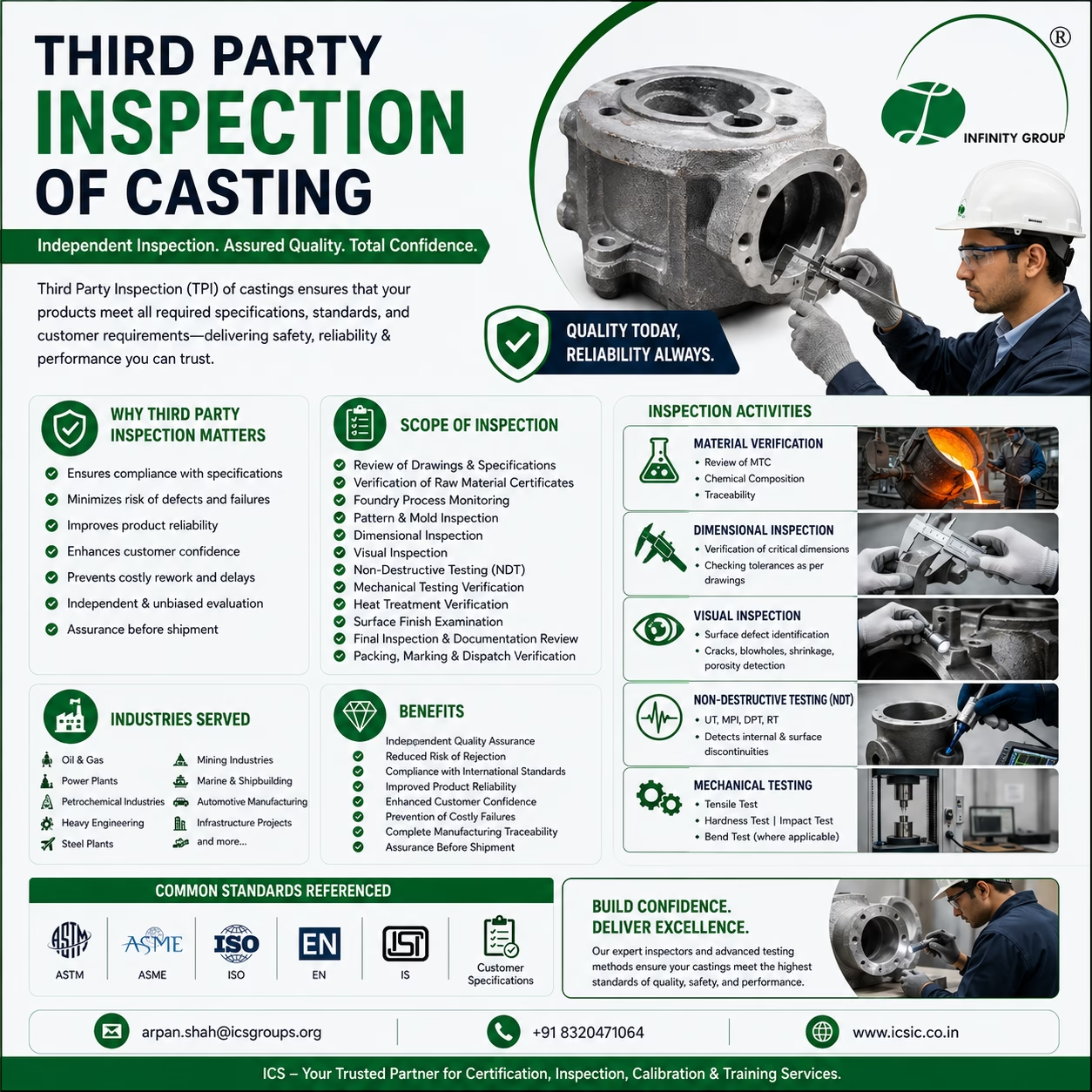
Third Party Inspection (TPI) of castings is an independent quality verification process conducted by a qualified inspection agency to ensure that cast components meet specified technical requirements, industry standards, customer specifications, and contractual obligations before dispatch.
TPI provides unbiased assurance regarding the quality, dimensional accuracy, material integrity, and performance of cast products.
🎯 Why Third Party Inspection is Important
Castings are widely used in critical industries such as oil & gas, power generation, automotive, mining, cement, marine, and heavy engineering. Defects in castings can lead to costly failures, downtime, and safety risks.
Independent inspection helps minimize risks by ensuring compliance at every stage of manufacturing.
🔎 Scope of Third Party Inspection for Castings
✅ Review of Approved Drawings & Specifications
✅ Verification of Raw Material Certificates
✅ Foundry Process Monitoring
✅ Pattern & Mold Inspection
✅ Dimensional Inspection
✅ Visual Inspection
✅ Non-Destructive Testing (NDT)
✅ Mechanical Testing Verification
✅ Heat Treatment Verification
✅ Surface Finish Examination
✅ Final Inspection & Documentation Review
✅ Packing, Marking & Dispatch Verification
🛠 Inspection Activities Performed
📋 Material Verification
- Review of Material Test Certificates (MTC)
- Chemical Composition Verification
- Traceability Verification
📏 Dimensional Inspection
- Verification of critical dimensions
- Checking tolerances as per drawings
- Measurement using calibrated instruments
👀 Visual Inspection
- Surface defect identification
- Verification of casting finish
- Detection of cracks, blowholes, shrinkage, and porosity
🔬 Non-Destructive Testing (NDT)
- Ultrasonic Testing (UT)
- Magnetic Particle Testing (MPI)
- Dye Penetrant Testing (DPT)
- Radiographic Testing (RT)
⚙ Mechanical Testing
- Tensile Test
- Hardness Test
- Impact Test
- Bend Test (where applicable)
🌟 Benefits of Third Party Inspection
🔹 Independent Quality Assurance
🔹 Reduced Risk of Rejection
🔹 Compliance with International Standards
🔹 Improved Product Reliability
🔹 Enhanced Customer Confidence
🔹 Prevention of Costly Failures
🔹 Complete Manufacturing Traceability
🔹 Assurance Before Shipment
🏗 Industries Served
✔ Oil & Gas
✔ Power Plants
✔ Petrochemical Industries
✔ Heavy Engineering
✔ Steel Plants
✔ Mining Industries
✔ Marine & Shipbuilding
✔ Automotive Manufacturing
✔ Infrastructure Projects
📌 Common Standards Referenced
📖 ASTM Standards
📖 ASME Standards
📖 ISO Standards
📖 EN Standards
📖 IS Standards
📖 Customer-Specific Specifications
🚀 Build Confidence with Independent Inspection
Third Party Inspection of castings ensures that every component delivered meets the highest standards of quality, safety, and performance. Independent verification reduces risks, protects investments, and enhances customer trust across the supply chain.
📧 arpan.shah@icsgroups.org
📞 +91 8320471064
🌐 www.icsic.co.in
ICS – Your Trusted Partner for Certification, Inspection, Calibration & Training Services.
#ThirdPartyInspection #TPI #CastingInspection #FoundryInspection #QualityInspection #IndustrialInspection #NDT #QualityAssurance #MechanicalInspection #EngineeringInspection #MaterialTesting #Foundry #ManufacturingQuality #InspectionServices #IndustrialQuality #ICSGroup #QualityControl #CastingQuality #InspectionAndTesting #EngineeringExcellence