When Should You Hire a Third-Party Inspection Agency? A Complete Guide for Manufacturers & Buyers
In manufacturing, engineering, fabrication, oil & gas, construction, and industrial projects, product quality cannot always be judged by appearance alone.
A component may look acceptable but still have dimensional deviations, incorrect material, welding defects, documentation gaps, or other nonconformities. When products are manufactured by external suppliers—especially at distant locations—the buyer may have limited visibility into what is actually happening during production.
This is where a professional Third-Party Inspection (TPI) Agency can add value.
Third-party inspection provides independent verification of products, materials, equipment, manufacturing activities, and documentation against specified requirements such as approved drawings, purchase orders, specifications, inspection and test plans, and applicable standards.
The question is: When should you hire a third-party inspection agency?
What Is Third-Party Inspection?
Third-Party Inspection is an independent inspection activity performed by an inspection organization that is separate from the manufacturer and the purchasing organization, subject to the agreed inspection arrangement.
The purpose is to provide an additional level of confidence that specified requirements have been fulfilled.
Depending on the agreed scope, a third-party inspector may verify:
Material → Manufacturing → Dimensions → Workmanship → Welding → Testing → Documentation → Final Product → Dispatch
The exact inspection activities should always be based on the contractual and technical requirements of the project.
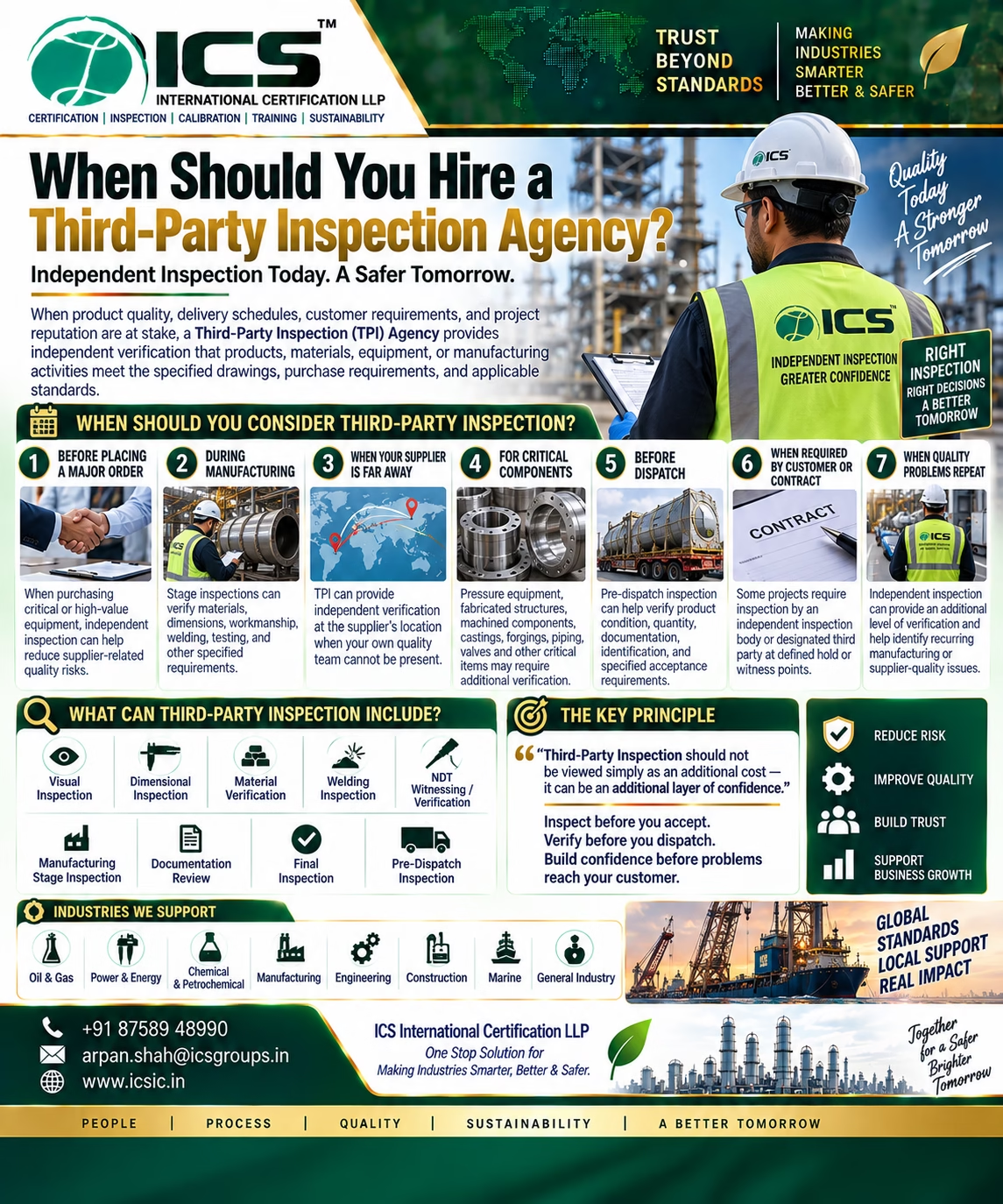
1. Before Placing a Major or High-Value Order
Large industrial purchases can involve significant financial and operational risk.
Examples may include:
- Pressure equipment
- Fabricated structures
- Mechanical components
- Valves
- Piping components
- Castings and forgings
- Machined components
- Process equipment
- Structural components
- Custom-engineered products
For critical or high-value purchases, planning third-party inspection before manufacturing begins allows inspection requirements to be incorporated into the purchase order, Quality Assurance Plan (QAP), Inspection and Test Plan (ITP), or other contractual documents.
This helps clarify:
What needs to be inspected? At what stage? Against which requirements? What records are required?
Early planning is generally more effective than arranging inspection only after a quality problem has occurred.
2. During Manufacturing
One of the most valuable uses of third-party inspection is stage inspection during manufacturing.
Waiting until the product is completely manufactured can sometimes be too late.
For example, an inspector may need to verify a material, weld, internal feature, test, or manufacturing stage before it becomes inaccessible during subsequent operations.
Depending on the agreed ITP or inspection scope, manufacturing-stage inspection may include:
- Incoming material verification
- Material identification
- Dimensional inspection
- Welding inspection
- Visual inspection
- NDT witnessing or verification
- Manufacturing process verification
- Review of test results
- Documentation review
- Intermediate dimensional checks
- Hold-point or witness-point activities
The principle is simple:
Find the problem when it can still be controlled—not after the product is completed.
3. When Your Supplier Is Far Away
Modern supply chains are increasingly global.
A buyer in one city, state, or country may purchase components from a manufacturer located hundreds or thousands of kilometres away.
Sending the buyer’s own engineers or quality personnel for every inspection can be costly and operationally difficult.
A competent third-party inspection agency can provide independent inspection at or near the supplier’s manufacturing location, subject to service availability and the agreed inspection scope.
The buyer can then receive relevant inspection documentation and findings to support its acceptance decisions.
This can be particularly useful for organizations managing multiple vendors across different locations.
4. When Purchasing Critical Components
Not every component carries the same level of quality risk.
Third-party inspection becomes particularly valuable when the failure or nonconformity of an item could significantly affect:
Safety | Performance | Reliability | Assembly | Project Schedule | Customer Requirements
Examples of items that may require enhanced inspection include:
- Pressure-containing components
- Pipes and tubes
- Valves and fittings
- Structural fabrications
- Welded components
- Machined components
- Castings
- Forgings
- Fasteners
- Tanks and vessels
- Mechanical assemblies
- Industrial equipment
The required inspection level should be determined based on the product, risk, contract, applicable requirements, and customer expectations.
5. Before Dispatch
A product leaving the supplier’s facility without adequate final verification can create expensive problems later.
Imagine discovering a dimensional deviation, incorrect quantity, missing document, or identification issue only after the material reaches the customer’s site.
The cost may then include:
Return Transportation + Rework + Replacement + Project Delay + Additional Inspection + Customer Dissatisfaction
A Pre-Dispatch Inspection (PDI) can provide an additional verification before shipment.
Depending on the agreed scope, pre-dispatch inspection may include:
- Product identification
- Quantity verification
- Visual condition
- Dimensional verification
- Marking and traceability
- Documentation review
- Test certificate review
- Packing requirements
- Final inspection status
- Other specified acceptance requirements
Verify before you dispatch—not after the customer receives it.
6. When the Customer or Contract Requires Independent Inspection
Some contracts, purchase orders, projects, or customer specifications explicitly require independent third-party inspection.
The documentation may define specific:
- Hold Points
- Witness Points
- Review Points
- Surveillance Activities
- Inspection Stages
- Documentation Requirements
For example, the purchaser may require an independent inspector to witness a test before the manufacturer proceeds to the next production stage.
In such situations, inspection should be performed according to the applicable contractual requirements and approved inspection documents.
7. When Supplier Quality Problems Keep Repeating
Repeated quality problems are an important warning sign.
Examples include:
- Recurring dimensional deviations
- Welding defects
- Incorrect material
- Poor workmanship
- Missing inspection records
- Incomplete material certificates
- Traceability issues
- Repeated customer complaints
- Incorrect packing or identification
When these problems occur repeatedly, third-party inspection can provide an additional independent verification layer.
However, inspection should not replace effective supplier quality management.
The long-term objective should remain:
Identify Problem → Determine Cause → Implement Corrective Action → Verify Effectiveness → Prevent Recurrence
What Does a Third-Party Inspector Check?
There is no single inspection checklist that applies to every product.
The inspection scope should be developed from the applicable:
- Purchase Order
- Approved Drawing
- Technical Specification
- Quality Assurance Plan
- Inspection and Test Plan
- Customer Requirements
- Applicable Codes and Standards
- Approved Procedures
- Acceptance Criteria
Depending on those requirements, inspection activities may include the following.
Visual Inspection
Verification of workmanship, surface condition, visible defects, damage, identification, and other specified visual characteristics.
Dimensional Inspection
Verification of dimensions and tolerances using suitable measuring equipment.
This may include diameter, bore, thickness, length, height, hole location, alignment, flatness, or other specified dimensional characteristics.
Material Verification
Verification of material identification, grade, traceability, certificates, and specified material requirements.
Welding Inspection
Verification of applicable welding-related requirements, such as approved procedures, welder qualification records, joint preparation, visual weld condition, and specified inspection or testing activities.
NDT Witnessing / Verification
Depending on the agreed scope, this may involve PT, MT, UT, RT, or other applicable NDT activities.
Documentation Review
Technical documentation can be as important as physical inspection.
Documents may include:
- Material Test Certificates
- Inspection Reports
- NDT Reports
- Calibration Records
- Welding Records
- Test Reports
- Heat Treatment Records
- Traceability Records
- Approved Drawings
- QAP / ITP Records
Final Inspection
The final inspection evaluates applicable specified requirements before acceptance, release, or dispatch.
Third-Party Inspection vs Quality Control: What Is the Difference?
These terms should not be confused.
Quality Control (QC) is generally part of the manufacturer’s processes for controlling and verifying product quality.
Third-Party Inspection (TPI) provides independent verification against specified requirements within an agreed inspection scope.
A strong arrangement may therefore involve:
Manufacturer QC + Independent Third-Party Inspection + Customer Oversight
These activities can complement each other rather than replace one another.
What Are the Benefits of Third-Party Inspection?
When properly planned and executed, third-party inspection can help organizations:
- Identify nonconformities earlier
- Verify specified product requirements
- Improve confidence in supplier quality
- Support dimensional and material verification
- Improve traceability and documentation
- Reduce the risk of receiving unacceptable products
- Support purchasing and acceptance decisions
- Reduce avoidable rework and delays
- Provide independent inspection evidence
- Improve customer confidence
Third-party inspection should therefore not always be viewed simply as an additional cost.
For critical products and projects, it can be an additional layer of risk control and confidence.
When Should Third-Party Inspection Start?
A common mistake is contacting the inspection agency only when the product is ready for dispatch.
For critical projects, inspection planning should ideally begin much earlier.
A more effective approach can be:
Purchase Requirement → Inspection Planning → Manufacturing Stage Inspection → Testing → Final Inspection → Documentation Review → Release / Dispatch
This allows important inspection stages to be identified before they are missed.
How to Select a Third-Party Inspection Agency
When selecting an inspection provider, organizations should evaluate more than price.
Consider factors such as:
Competence of Inspectors – Are inspectors technically competent for the required product and inspection activity?
Relevant Inspection Scope – Can the inspection organization perform the required type of inspection?
Independence and Impartiality – Can the inspection activity be conducted objectively?
Technical Capability – Does the provider understand relevant drawings, specifications, inspection plans, methods, and acceptance requirements?
Reporting – Are inspection findings clearly documented and traceable?
Geographical Coverage – Can inspection be arranged where your suppliers are located?
For formal inspection-body requirements, the applicability of standards such as ISO/IEC 17020 may also be relevant depending on the contractual, regulatory, accreditation, or customer requirement.
Industries That Use Third-Party Inspection
Third-party inspection is used across a wide range of industries, including:
Oil & Gas | Petrochemical | Power & Energy | Manufacturing | Engineering | Construction | Infrastructure | Heavy Engineering | Marine | Mechanical Fabrication | General Industry
The inspection method and scope will vary according to the product and its intended application.
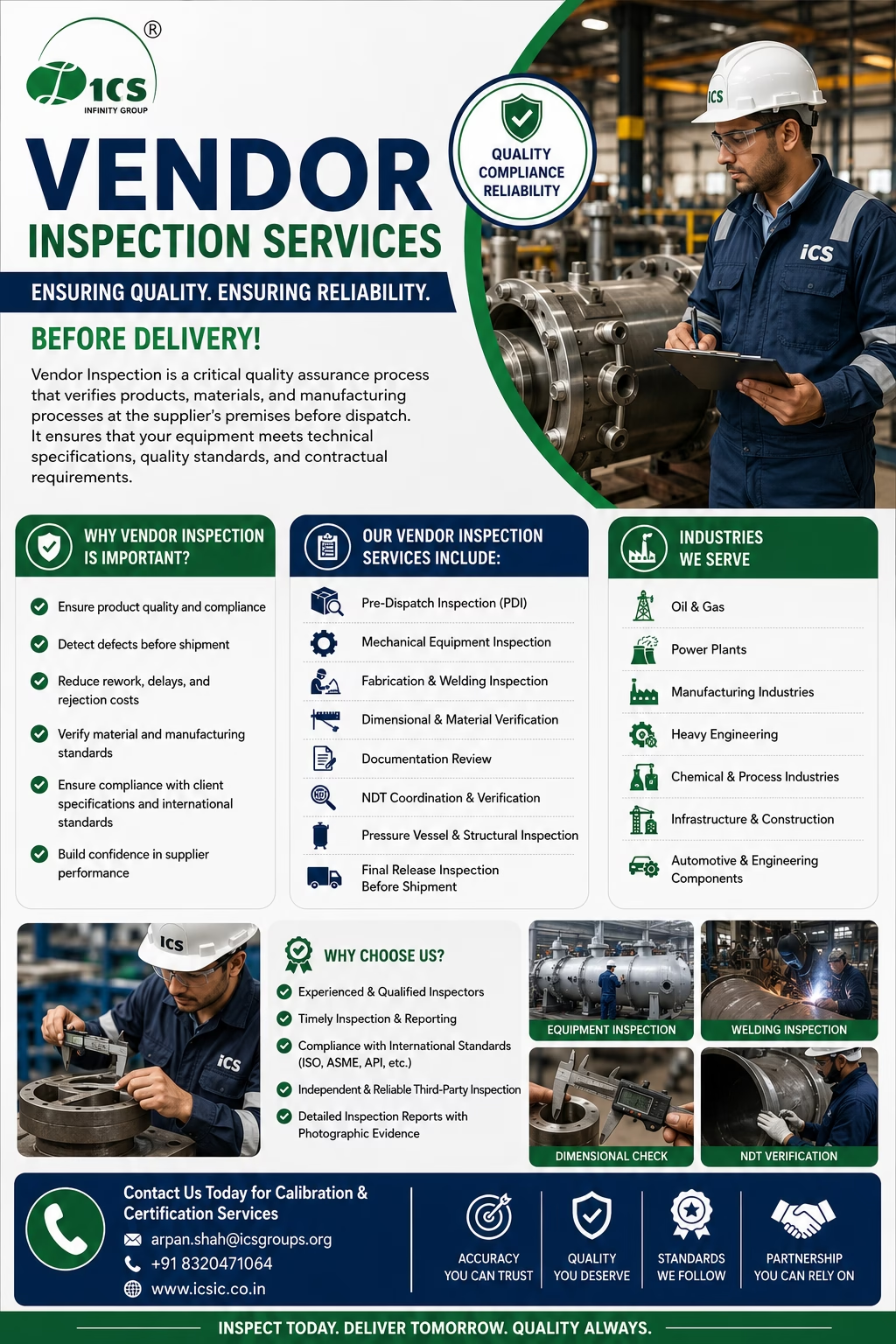
Third-Party Inspection Services by ICS International Certification LLP
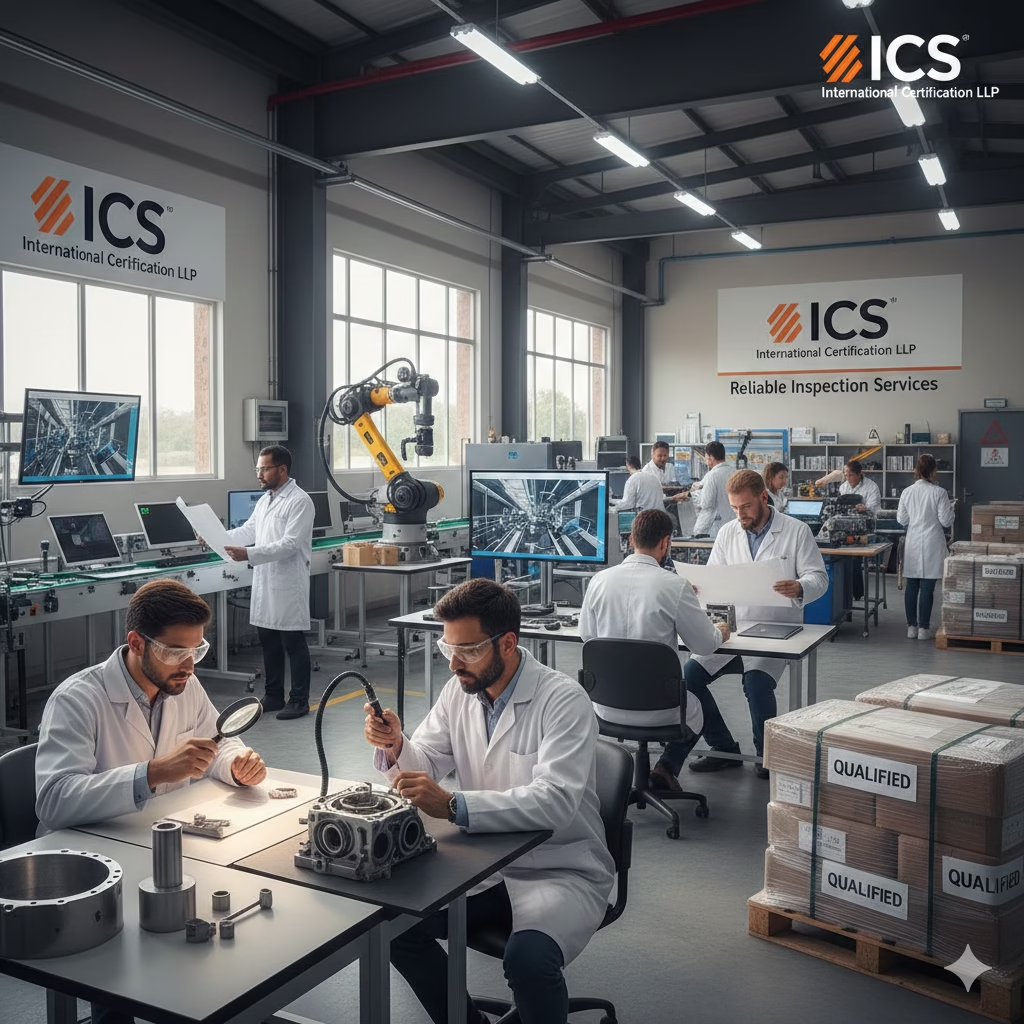
At ICS International Certification LLP, we support manufacturers, purchasers, engineering organizations, project companies, and industrial clients with professional inspection and quality services.
Our services include:
Third-Party Inspection | Dimensional Inspection | Mechanical Component Inspection | Casting Inspection | Fabrication Inspection | Welding Inspection | Visual Inspection | NDT | Pre-Dispatch Inspection | Calibration | Quality Inspection
Our approach focuses on independent verification against the agreed drawings, specifications, purchase requirements, inspection plans, and applicable acceptance criteria.
Independent Inspection. Reliable Verification. Greater Confidence.
Inspect before you accept. Verify before you dispatch. Build confidence before problems reach your customer.
For Third-Party Inspection requirements:
ICS International Certification LLP
📞 +91 87589 48990
📧 arpan.shah@icsgroups.in
🌐 www.icsic.in
One Stop Solution for Making Industries Smarter, Better & Safer.
Frequently Asked Questions About Third-Party Inspection
What is a Third-Party Inspection Agency?
A third-party inspection agency independently inspects products, materials, equipment, manufacturing activities, or related documentation against defined requirements within an agreed inspection scope.
When should I hire a Third-Party Inspection Agency?
Consider third-party inspection for critical or high-value orders, remote suppliers, manufacturing-stage verification, contractual inspection requirements, recurring supplier-quality problems, and pre-dispatch verification.
What is Pre-Dispatch Inspection?
Pre-dispatch inspection is performed before shipment to verify specified product, quantity, condition, documentation, identification, dimensional, or other applicable requirements according to the agreed inspection scope.
Can a Third-Party Inspector perform dimensional inspection?
Yes, where included within the agreed scope and technical capability. Dimensional inspection may involve verification of dimensions, tolerances, bores, diameters, thicknesses, alignment, or other specified characteristics using suitable measuring equipment.
Does Third-Party Inspection replace the manufacturer’s QC?
Generally, no. Manufacturer quality control and independent third-party inspection perform different functions and can complement each other.